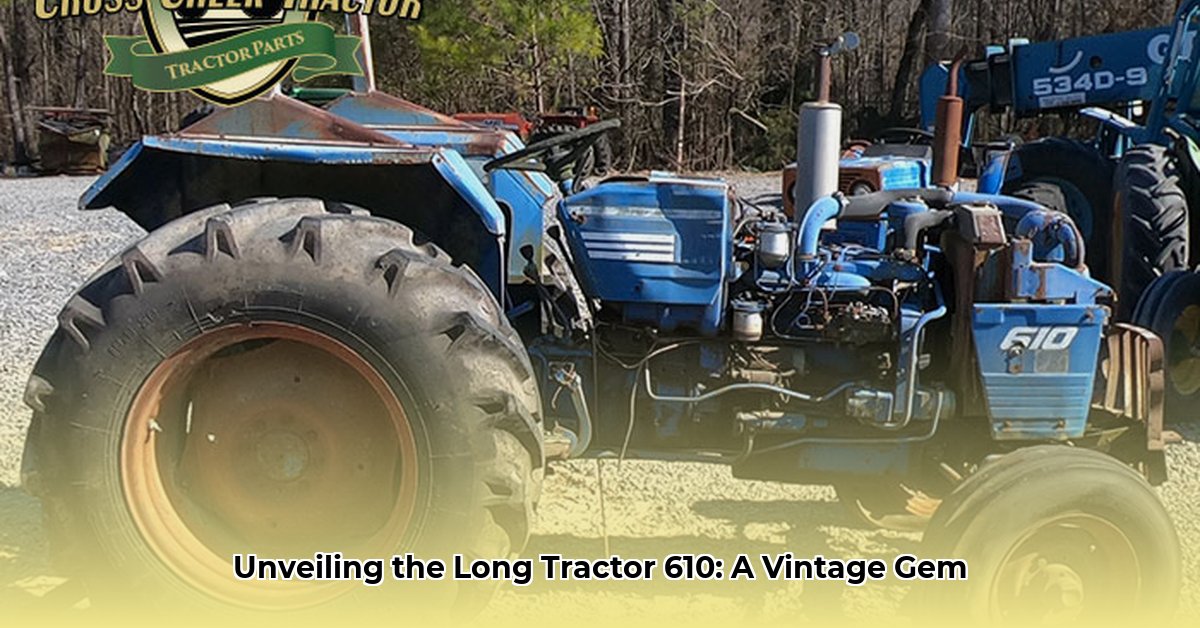
The Long 610 tractor, a stalwart of the 1980s farming landscape, represents a bygone era of robust, no-frills agricultural machinery. While not known for flashy aesthetics, its reliable performance cemented its place in the hearts of many farmers. This article delves into the technical specifications and historical context of this intriguing machine, highlighting its strengths and limitations. But first, a critical question: What exactly made the Long 610 such a dependable workhorse? For more on vintage tractors, check out this helpful resource: vintage tractor info.
Power and Performance: A Dependable Workhorse
The Long 610's heart was a 3.6-liter UTB/Universal 4-cylinder diesel engine, a testament to the engineering of its time. This powerplant delivered approximately 56 horsepower at the drawbar (where implements like plows are attached) and around 64 horsepower at the PTO (power takeoff shaft), used for powering equipment like hay balers. For its era, this was substantial power—enough to handle demanding agricultural tasks with aplomb. How did this power translate into real-world performance? Farmers consistently praised its ability to tackle tough fields and haul heavy loads with dependable efficiency.
Its 8-speed partially synchronized transmission, while lacking the smoothness of modern equivalents, provided sufficient gear ratios for diverse farming operations. The 540 RPM PTO (operating at 2160 engine RPM) ensured compatibility with a wide range of implements. The engine's rhythmic chug became a familiar soundtrack to generations of farmers—a reliable companion in the fields. While not technologically advanced, its simplicity fostered dependability.
Hydraulics and Features: Simple but Effective
The Long 610 employed a relatively simple hydraulic system, featuring a 4.25-gallon reservoir and a single valve. This contrasts with the complex hydraulics found in modern tractors. However, this design was in line with the technology of the time and sufficient for the tasks typically performed. What was the trade-off with this straightforward design? Reduced versatility compared to modern tractors with advanced hydraulic systems.
Buyers could choose between two-wheel drive (2WD) or four-wheel drive (4WD) configurations, catering to varying terrain and operational needs. A mechanical rear differential lock and power steering enhanced maneuverability and ease of operation. The open operator station, though basic, featured an optional roll-over protective structure (ROPS) for enhanced safety. A cab was available for added weather protection. For many farmers, practical considerations like reliability outweighed the allure of more advanced features. The later addition of a front-end loader option significantly expanded the tractor's utility.
Unanswered Questions and Future Research
Despite its compelling history, information about the Long 610 remains surprisingly scarce. Precise production numbers and sales data are limited, hindering a complete understanding of its market success. This data gap also makes it difficult to definitively place the Long 610 amongst its contemporaries. What does this mean for researchers? Further investigation is critical to complete the historical record.
While online sources offer some details, the full story remains untold. More in-depth archival research is needed to unlock the complete history of the Long 610. Could dealer records, farmer testimonials, or perhaps even marketing materials shed more light on this agricultural workhorse? The potential for discovery is significant.
A Snapshot in Time: Contextualizing the Long 610
The Long 610's design elements reflect the prevailing agricultural technology of the mid-1980s. Its features, such as the relatively low hydraulic flow rate and partially synchronized transmission, were common at the time. The use of spur gears in the final drive, while less efficient than modern designs, was typical of the era. Its initial release in 1983, with the addition of the front-end loader in 1993, indicates a proactive attempt to stay competitive in the evolving agricultural machinery market. This adaptation underscores the tractor's lasting appeal and adaptability.
How to Find a Long 610 Tractor Today
Finding a Long 610 for sale can feel like a treasure hunt, especially given their age. This section details a multi-faceted approach.
Online and Offline Resources
Your search should leverage both online and offline approaches.
Specialized Online Marketplaces: Start with websites focused on classic and vintage tractors. These are dedicated platforms for buying and selling these machines.
General Classifieds: Don't overlook broader classifieds sites – you never know what hidden gems might surface.
Online Tractor Forums: Engage with online communities of vintage tractor enthusiasts. They are excellent sources of information and potential leads.
Local Auctions: Keep an eye on auction listings; many agricultural auctions feature older equipment.
Antique Tractor Shows and Events: Attending shows increases your chances of making direct connections with collectors and sellers.
Word-of-Mouth: Network with farmers, mechanics, and collectors in your area. Personal connections can yield valuable leads.
Refining Your Search: Patience and Precision
Finding a Long 610 requires patience and a systematic approach.
Define Your Needs: Specify the year, condition, and desired features to focus your search.
Set a Budget: Vintage tractors can vary significantly in price. Knowing your budget prevents impulsive purchases.
Be Prepared to Travel: The perfect tractor might be located some distance away.
Key Takeaways: The search for a Long 610 is a journey. Persistence, utilizing various resources, clearly defined parameters, and a realistic budget significantly increase your success rate. The reward of owning this piece of agricultural history makes the effort worthwhile.